This one’s ai-slop, as advertised on the about page.
My work laptop has about 35 CMUX workspaces open. Each one is an agent session, a worktree, or a half-finished thought. I had stopped knowing which ones had uncommitted changes, which had PRs waiting, and which the agent considered finished. My browser was worse: a hundred tabs, each one a task I meant to do or an article I meant to read, none of them findable.
There is now a product page for taude-bot listing every feature.
So I sat down with Claude to design the thing I wanted instead. It is called Taude (it rhymes with Claude, duh). The brief was one word long: quiet. It should keep track of everything without a lot of fanfare.
The ten main ideas
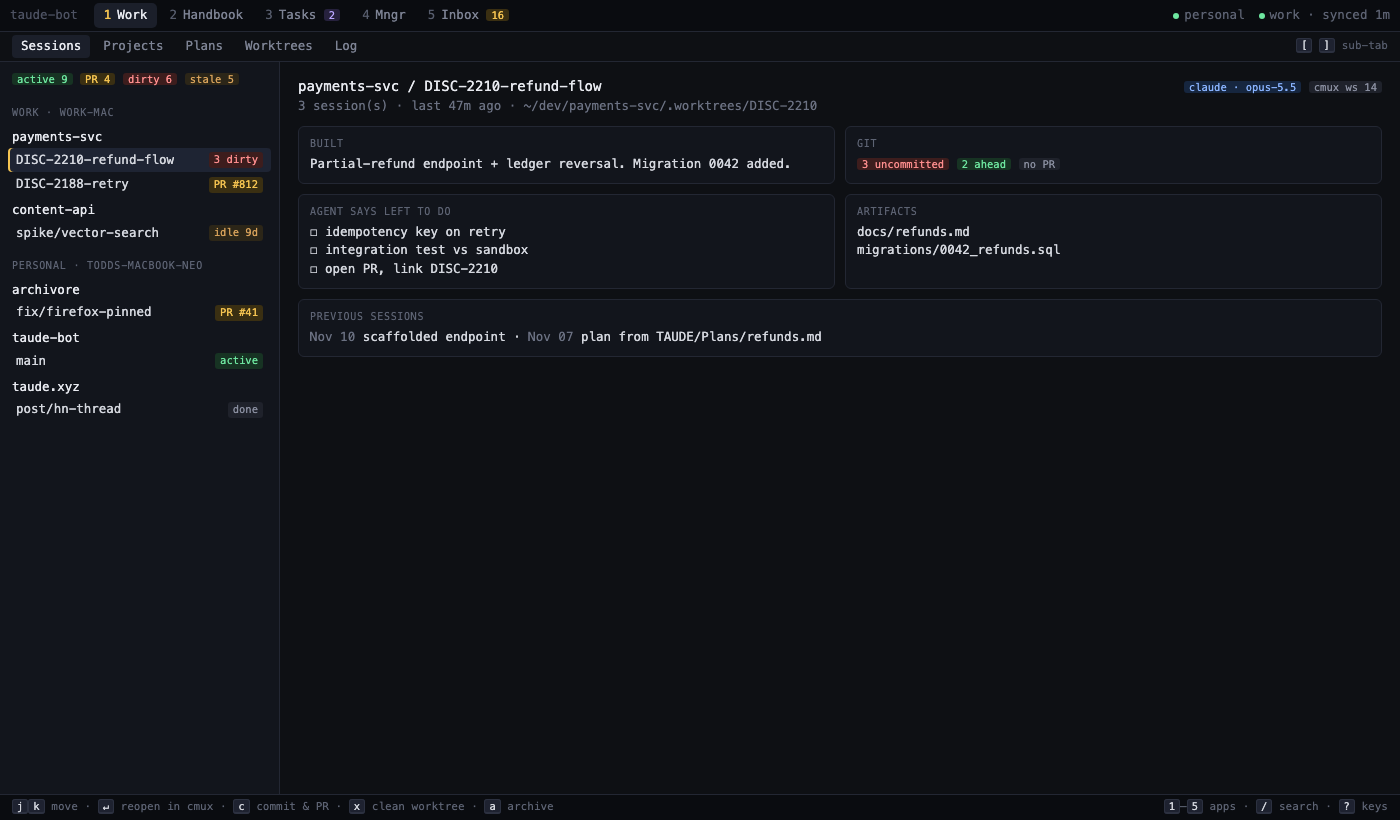
- Mission control for AI coding sessions. One screen shows every Claude Code, pi and opencode session for each laptops: what each built, uncommitted changes, PRs waiting to merge, and what the agent thinks is still left to do.
- Close anything, reopen it later. Every session writes a short wrap-up when it ends. One keypress reopens it in the right coding workspace with the agent’s memory intact.
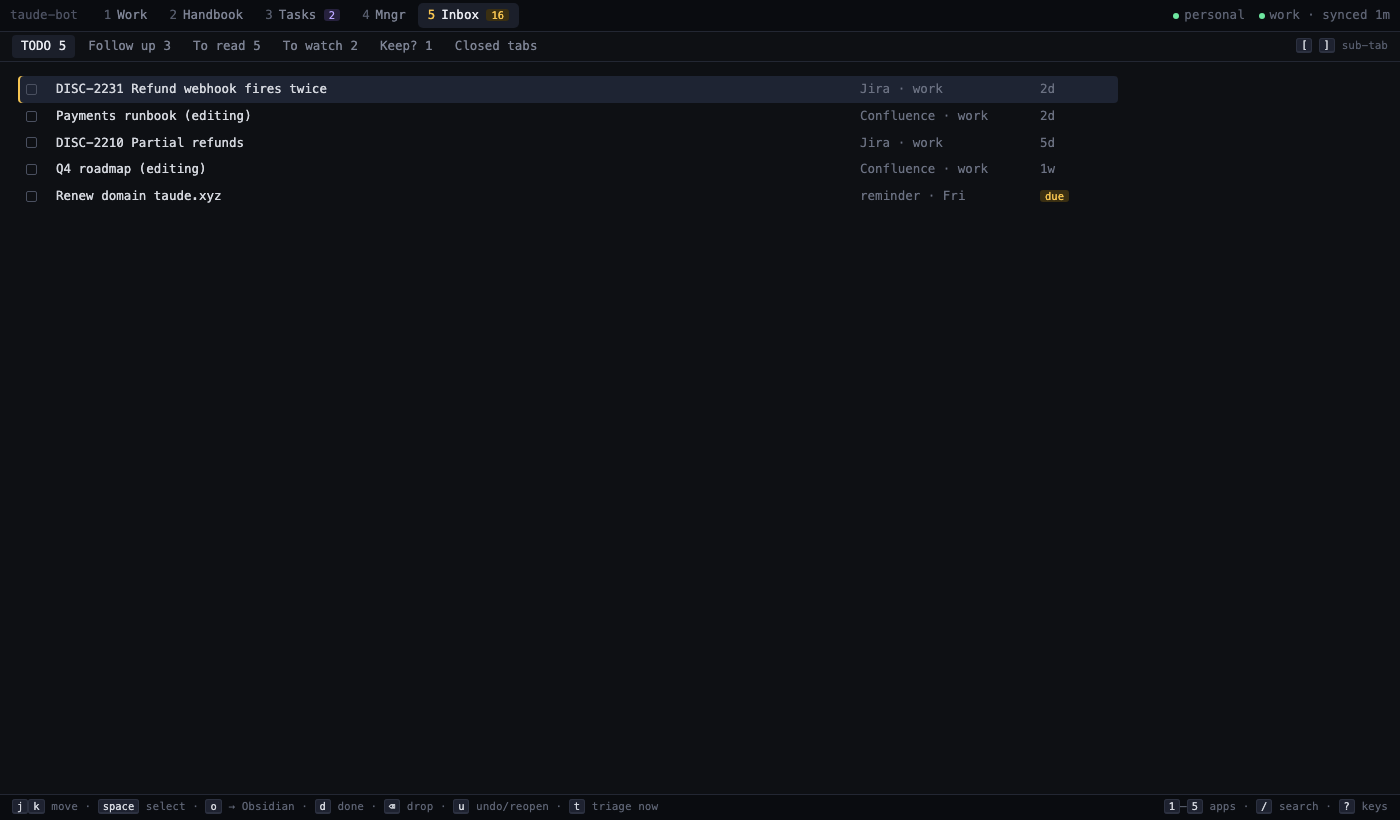
- Tab bankruptcy, automated. Daily and at Friday shutdown it sweeps Chrome and Firefox tabs into lists. Jira tickets and Confluence pages I was editing become TODOs; pages I was only reading become follow-ups; Hacker News becomes reading (article and comments paired); YouTube goes to watch. Then it closes everything except pinned tabs, with a one-key “reopen all”. No tabs survive the weekend.
- A homemade browser extension.
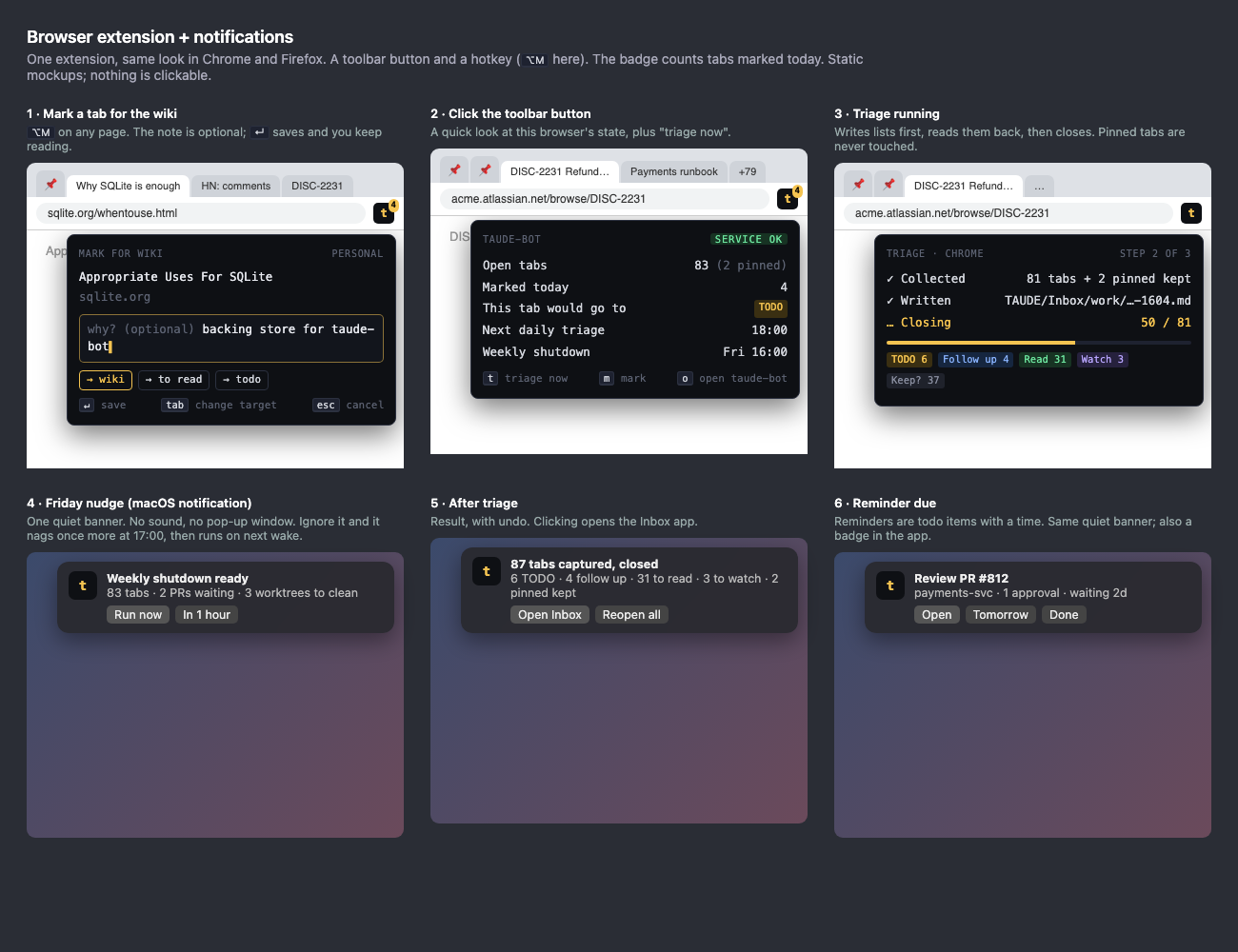
⌥Mon any page sends it to my personal LLM wiki, with an optional note on why it caught my eye. - Agent workflows on a schedule. Daily shutdown, weekly shutdown, writing the newsletter, processing my reading archive into wiki pages: all run in the background. Anything public waits in a review pile for approval.
- It suggests content. It notices what I shipped and offers to draft the blog post, newsletter or LinkedIn post, using what archivore captured.
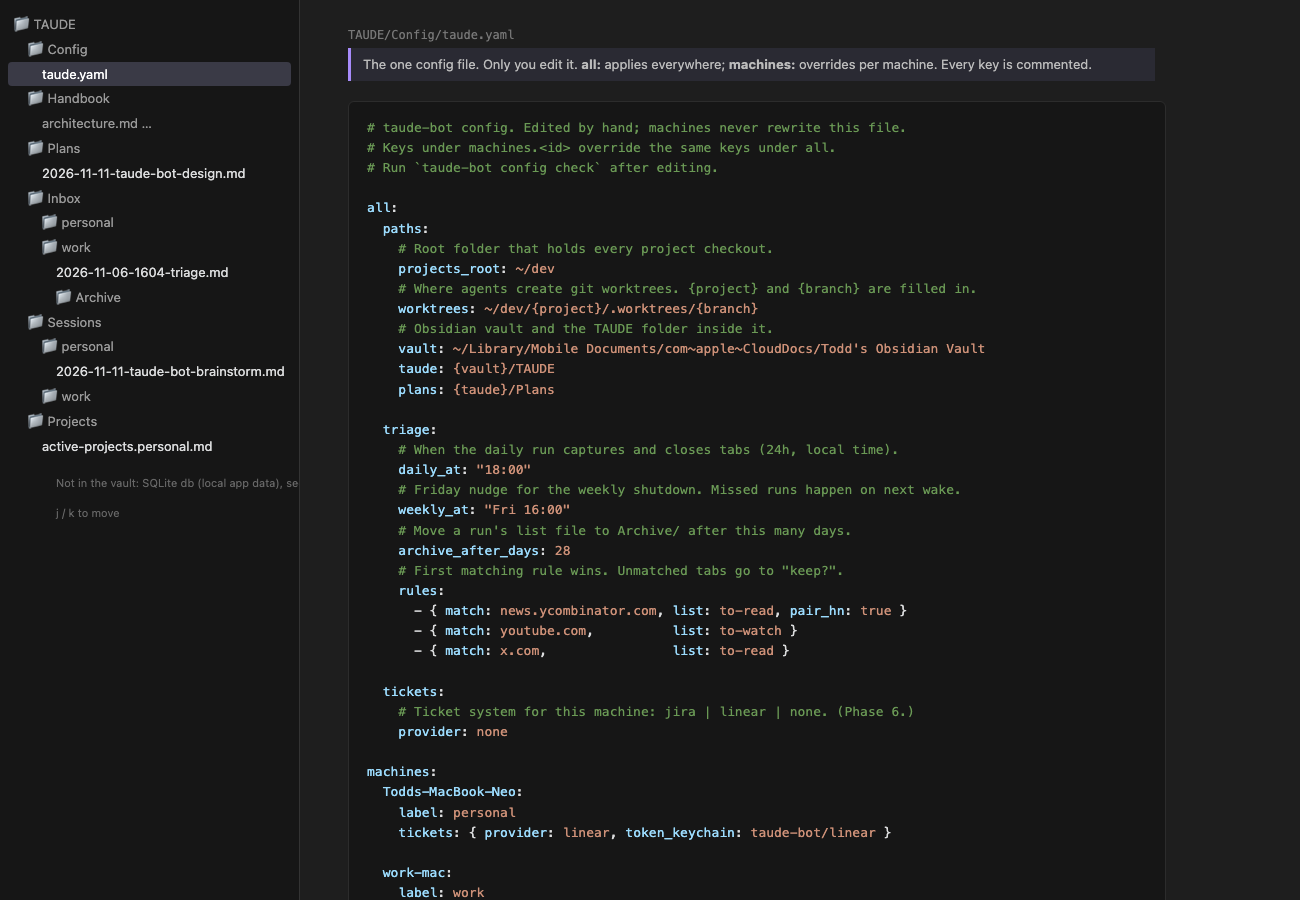
- Plain markdown in Obsidian. Plans, session logs, task lists and a handbook live in the vault, synced by iCloud. Each machine writes only its own files, so nothing ever conflicts.
- Keyboard everything. Number keys switch apps (Work, Handbook, Tasks,
Mngr, Inbox),
[and]flip sub-tabs,j/kmove,/searches everything. Dark, dense and fast; Orca was the visual inspiration. - Fast, native, local. A Go backend in a lightweight Wails window, which runs on Mac, Windows and Linux. A SQLite database per machine. Nothing in the cloud.
- Plug in any tool. One ticket view over whichever tracker each machine uses (Jira at work, Linear at home). One self-documenting YAML config with shared and per-machine sections. One install script, one GitHub repo.
What the mockups look like
Claude built these as throwaway HTML files with working hotkeys and fake data. The data is invented and the employer details are scrubbed.
The Work app. Sessions on both laptops on the left, the selected session’s wrap-up on the right:
The Inbox app, where triaged tabs land. Select a batch with the space bar and send it to Obsidian, mark it done, or drop it:
The browser extension and the notifications. One quiet banner on Friday afternoon, no sounds, no modal windows:
And what actually lands in the vault: one commented YAML config, one markdown file per triage run, one per session:
How it fits together
Reduced to its essentials: every source of mess reports into a small local service on each machine. Each service writes its own files into the vault, iCloud carries them to the other laptop, and each window reads both.
flowchart TD
  E[browser extension] --> S[local Go service]
  H[agent session hooks] --> S
  G[git, gh, CMUX] --> S
  S --> DB[(SQLite, per machine)]
  S --> V[TAUDE folder in the vault]
  V <--> O[other laptop]
  DB --> W[Wails window]
Decisions worth noting
A few came out of the conversation rather than the brief:
- SQLite stays out of iCloud. I wanted SQLite for persistence. Claude pointed out that syncing a live database file through iCloud invites corruption, so each machine keeps its own database locally and the markdown in the vault is what travels between machines.
- An extension, because the alternatives cannot close tabs safely. Archivore reads Chrome tabs through AppleScript, which cannot see pinned tabs, and Firefox’s session file is read-only. “Close everything except pinned” needed a real extension.
- The daily sweep has two modes.
logrecords tabs;wiperecords and closes them. It starts onloguntil I trust it. - Phase 1 is the boring part. Tab triage, the extension and a skeleton service come first. Session tracking, the full dashboard, workflows and ticket systems each get their own design pass later.
Session stats
The session ran on November 11th, 2026, from 11:02 to 15:06 UTC, a little over four hours. Across 106 assistant turns it used 340 fresh input tokens, 181,366 output tokens, 299,818 cache-creation tokens and 8,696,262 cache-read tokens, about 9.2 million in all. That total overstates the cost: cache reads are billed at a fraction of fresh input, and most of them are Claude re-reading context it had already built up. The figures come from parsing Claude Code’s transcript format, which is not a stable public API, so treat them as best-effort.